












AC Maintenance in UAE
AC Maintenance in UAE — What Actually Needs Doing and How Often
The air conditioning maintenance market in the UAE is, frankly, a mixed bag. On one end you have genuinely good HVAC companies with trained technicians, proper tools, and an honest understanding of what a system needs to stay efficient. On the other end, you have companies sending a man with a vacuum cleaner and a spray bottle to rinse the filter for twenty minutes, charge you AED 150 for an annual maintenance contract, and call it done. The gap between these two experiences — in terms of what actually happens to your AC and your electricity bill — is enormous.
Understanding what good AC maintenance actually looks like in the UAE helps you evaluate any contractor you hire, ask the right questions, and know whether the work being done is worth what you are paying for it.
Why UAE Conditions Make Maintenance More Critical Than Anywhere Else
Air conditioning systems in the UAE operate under conditions that most equipment was not originally designed for. The outdoor ambient temperature during peak summer sits between 42 and 48°C for weeks at a time — well above the rated conditions at which most manufacturers publish their efficiency specifications. The air carries fine desert dust that penetrates through any gap in a building envelope and settles on every surface, including evaporator coils, condenser coils, and drainage systems. In coastal areas, salt-laden air accelerates corrosion on condenser fins, copper tubing joints, and electrical connections.
None of this is an excuse for a poorly maintained system. It is the reason why maintenance intervals that might be adequate in a European or North American climate are genuinely insufficient in the UAE. A system that can run for a year between services in Amsterdam needs attention every four to six months in Dubai or Abu Dhabi if you want to maintain anything close to its rated efficiency.
What Should Actually Happen in a Proper AC Service Visit
A proper AC maintenance visit in the UAE covers the following, and anything less than this is not delivering the value the maintenance contract promises.
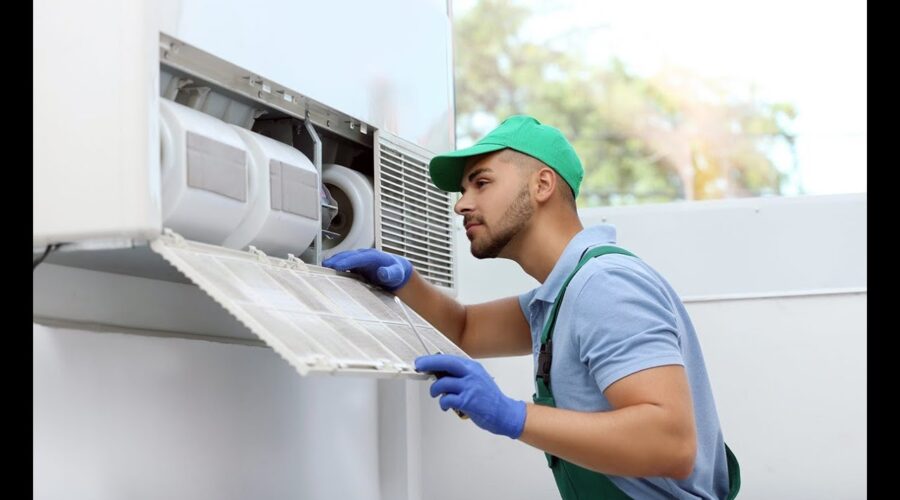
The evaporator coil — the indoor unit’s heat exchange surface — needs to be cleaned properly, not just rinsed. Fine dust in UAE air bonds to the coil’s moisture-covered surface during operation and builds up into a compacted layer that a simple water rinse will not remove. A proper cleaning uses a coil cleaning chemical that breaks down the bound dust, followed by rinsing to remove the chemical and loosened contamination. This process is uncomfortable, messy, and takes time. If a technician is in and out of your property in under an hour for a complete AC service, the coil has not been properly cleaned.
The condensate drain tray and drain line need to be inspected and cleared. In UAE’s humid summer conditions, the drain tray collects significant moisture that must drain continuously. Algae and mould build up in the tray and block the drain line — a blocked condensate drain causes the tray to overflow, which means water dripping from your indoor unit onto the ceiling, wall, or floor. This is one of the most common AC problems in UAE buildings and it is entirely preventable with proper maintenance. Any technician who does not check the condensate drain is not doing their job.
The outdoor condenser coil needs to be checked and cleaned. The condenser sits outside in the UAE heat, dust, and in coastal areas, salt air. Over a season, the aluminium fins on the condenser coil become clogged with dust and the fin surfaces corrode in coastal environments — both effects reduce the coil’s ability to reject heat into the outdoor air, which raises condensing pressure and increases compressor power draw significantly. A technician who only looks at the indoor unit and ignores the outdoor unit is missing the component that typically has the bigger maintenance impact on efficiency.
Refrigerant operating pressures should be checked with gauge sets at every service. This is the only reliable way to identify a slow refrigerant leak before it becomes a serious performance problem. If a technician tells you the system is fine without having connected gauge sets to the service ports and checked the operating pressures, they have not verified the refrigerant charge. They have assumed it is fine.
Electrical connections should be inspected and tightened. In UAE’s temperature extremes, electrical connections in the outdoor unit — at the terminal block, compressor leads, and capacitor connections — expand and contract thermally over thousands of operating hours and can loosen over time. A loose connection creates resistance, which generates heat, which accelerates deterioration, which eventually causes a failure. Checking and tightening electrical connections takes minutes but prevents failures that are expensive to diagnose and repair in the middle of summer.
The air filter is the one component most people do know about. In UAE conditions, it needs checking monthly during peak summer operation and cleaning or replacing every one to three months depending on the local dust level. If you are in a villa near open desert or a building going up next door, more frequent checks are necessary. A visually blocked filter is starving the system of airflow — every cooling system needs adequate airflow through the evaporator to work efficiently.
How Often to Service AC in UAE
For residential split systems in most UAE locations, a full professional service twice a year — once before the summer season begins (March to April) and once midway through (July to August) — is the right baseline. Add to that a monthly filter check that a homeowner can do themselves in ten minutes. For commercial systems running longer hours and serving higher-occupancy spaces, quarterly professional service is more appropriate.
VRF systems and central plant — chillers, air handling units, and fan coil systems — need quarterly preventive maintenance at a minimum, and monthly monitoring of performance data if the building management system is capable of logging it. A chiller that is operating at degraded efficiency is wasting enormous amounts of electricity — the payback on identifying and fixing a performance issue in a large commercial chiller is measured in thousands of dirhams per month.
Annual Maintenance Contracts — What to Look For and What to Avoid
Annual maintenance contracts for residential AC in the UAE are offered at every price point from AED 80 to AED 500 per unit per year. The cheap end is almost universally inadequate — it covers a single filter-rinse visit per year and nothing else. A legitimate AMC for a residential split system should include two full service visits covering everything described above, priority emergency response if the system fails, and parts discounts or inclusion for standard consumables like filters.
For commercial AMCs, the contract should specify exactly what is included at each visit, the response time commitment for emergency calls, and whether refrigerant gas consumed during the contract period is included or charged separately. Refrigerant can be a very significant cost if a system has a slow leak — some AMC providers structure their contracts to benefit from repeated refrigerant top-ups rather than finding and fixing the underlying leak. A good contractor finds and fixes the leak. A contractor who keeps your system running by topping up refrigerant every few months without ever pressure-testing for leaks is charging you for gas you should not need.
When Maintenance Is Not Enough and Replacement Makes More Sense
At some point, continued maintenance of old AC equipment stops being economical. The signs that replacement is worth considering are: the compressor has been replaced once already and is starting to perform poorly again, the system requires refrigerant top-up more than once a year (indicating a leak that cannot be economically repaired), the EER rating of the existing unit is significantly below what current equipment achieves, or the unit is more than 12 to 15 years old and beginning to require increasingly frequent attention.
A genuine AC equipment supplier or HVAC contractor in UAE — rather than purely a maintenance company — can give you an honest view of when the economics of maintaining an aging system have passed the break-even point versus replacing it with more efficient equipment. That conversation is worth having with a supplier who carries replacement equipment and has no interest in keeping an inefficient old system running indefinitely at your expense.
Finding Reliable AC Maintenance and Equipment Suppliers in UAE
The AC equipment suppliers and HVAC companies listed on UAE Yellowpages across Dubai, Sharjah, Abu Dhabi, and the Northern Emirates include companies that provide both equipment supply and maintenance services. When choosing an AC maintenance provider, ask specifically about their service scope, whether they use chemical coil cleaning, whether they check refrigerant charge on every visit, and whether their technicians are trained and certified for the brands they service. Those questions will tell you very quickly whether you are dealing with a serious company or one that has found a business model based on collecting AMC fees while doing as little as possible.