Chain Link Fencing in UAE: The Ultimate Guide from Leading Fencing Suppliers
Introduction: Why Chain Link Fencing Dominates the UAE Market
In a market as diverse and demanding as the UAE, chain link fencing has earned its position as the most widely specified fencing solution across virtually every sector. From the sprawling industrial zones of Dubai Investment Park and Khalifa Industrial Zone Abu Dhabi (KIZAD) to school playgrounds, sports facilities, and even residential boundary walls, chain link fencing’s unique combination of strength, adaptability, and cost-effectiveness makes it the go-to choice for architects, contractors, and property owners alike.
As any experienced fencing supplier in UAE will confirm, chain link fencing has come a long way from the simple woven wire mesh of previous generations. Modern chain link systems feature advanced galvanization processes, precision-engineered wire diameters, and a broad spectrum of PVC coating colors, giving designers and specifiers unprecedented flexibility to create fencing solutions that are both highly functional and visually aligned with their project’s aesthetic requirements. This comprehensive guide explores every dimension of chain link fencing in the UAE context — from materials and technical specifications to installation procedures and maintenance best practices.
Understanding Chain Link Fencing: Materials and Manufacturing
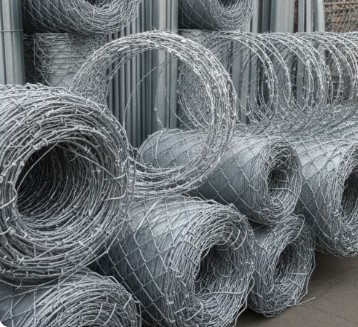
Chain link fencing, also known as cyclone fencing or hurricane fencing, is manufactured by weaving a continuous length of wire into a series of interlocking spirals or helices to form a diamond-pattern mesh. The structural integrity of the finished fence depends on three primary variables: wire material, wire diameter, and mesh aperture.
In the UAE market, galvanized iron (GI) wire is the standard material for chain link fencing, with stainless steel specified for environments where superior corrosion resistance is required — such as coastal installations, food processing facilities, and chemical plants. Wire diameters typically range from 1.5 mm for light-duty garden and decorative applications to 5.0 mm for heavy-duty industrial and security fencing. Mesh apertures of 50 mm × 50 mm are the most common specification, though 25 mm × 25 mm apertures are available for higher-security applications where anti-intrusion properties are paramount.
The galvanization process is critically important for performance in the UAE’s harsh climate. Pre-galvanization involves coating the wire before weaving, producing a smooth finish with consistent zinc coverage. Post-galvanization, also known as hot-dip galvanization after fabrication, applies the zinc coating after the mesh is woven, providing heavier zinc deposition and superior corrosion resistance at the cut wire ends — the most vulnerable points in any mesh fence. Leading fencing suppliers in UAE offer both options, with hot-dip post-galvanized mesh recommended for coastal areas, industrial zones, and any application where maximum longevity is required.
Technical Specifications: What to Demand from Your Fencing Supplier in UAE
When specifying chain link fencing for a UAE project, insisting on precise technical documentation from your fencing supplier is not merely good practice — it is essential for ensuring compliance with project specifications, international standards, and local authority requirements.
Key specifications to confirm include zinc coating weight, which should meet or exceed the requirements of BS EN 10244-2 or ASTM A392 for galvanized coatings. For hot-dip galvanized mesh, a minimum zinc coating weight of 245 g/m² is the standard benchmark. PVC coating thickness, where specified, should be a minimum of 0.4 mm for standard applications and 0.8 mm or greater for heavy-duty installations.
Post and rail specifications are equally important. Line posts for standard chain link installations are typically 40 mm or 48 mm outside diameter galvanized steel tube, set in concrete foundations at depths calculated according to fence height and soil bearing capacity. Terminal posts at corners, gate openings, and ends of fence runs are typically heavier gauge or larger diameter to accommodate the increased loading from tension wires and fabric.
Breaking load and tensile strength data should be available from any reputable fencing supplier in UAE. For industrial and security applications, request third-party test certificates confirming wire tensile strength and zinc coating adherence. This documentation is particularly important for government projects and developments requiring LEED or Estidama certification, where material compliance documentation forms part of the submission package.
Chain Link Fencing Applications Across UAE Sectors
The versatility of chain link fencing means that a quality fencing supplier in UAE must be able to serve an extraordinarily diverse range of applications with equally varied performance requirements.
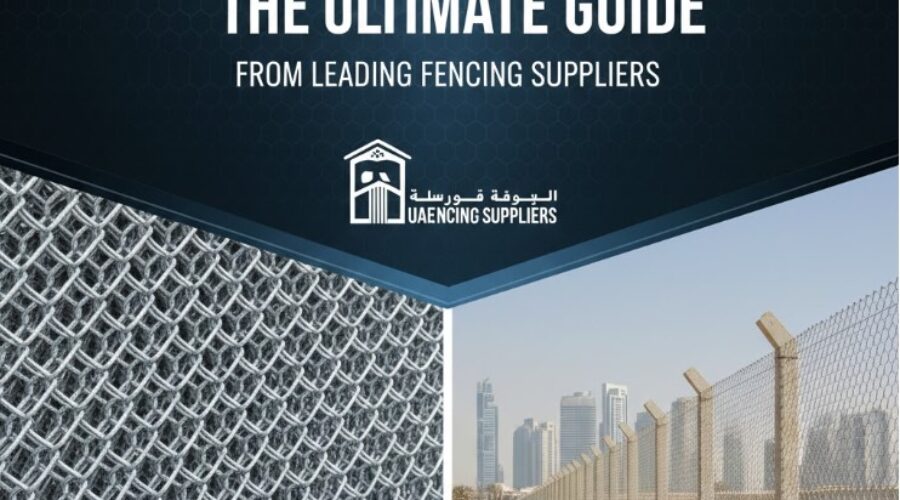
In the industrial sector, chain link fencing forms the primary perimeter security boundary for factories, warehouses, logistics centers, and storage yards throughout the UAE’s major industrial zones. Standard specifications for industrial chain link in Dubai and Abu Dhabi typically call for 3.0 mm to 4.0 mm wire diameter, 50 mm aperture, hot-dip galvanized mesh, and 2.4 m to 3.0 m fence height with three lines of barbed wire on V-arm extensions at the top — creating a total effective security height of approximately 3.6 m.
For school and educational facility fencing, the specifications shift toward child safety and visibility for supervision. Lighter gauge mesh, rounded post caps, and the elimination of sharp projections at accessible heights are all important considerations. PVC-coated chain link in green or black is popular for school fencing in the UAE as it blends with landscaping and presents a less institutional appearance than bare galvanized mesh.
Sports facility fencing represents a major specialized application. Tennis courts, football pitches, multi-use games areas, and athletics facilities all require fencing systems optimized for ball containment. Rebound endurance, resistance to impact loading, and the ability to accommodate gates in multiple locations are the defining requirements. Sports fencing chain link is typically specified at 3.5 m to 5.0 m height with additional horizontal rails to prevent ball exit over the top.
Construction site hoarding using temporary chain link fencing is another important application segment. Temporary chain link panels mounted on steel stakes or concrete feet allow rapid deployment around active construction sites, protecting the public from site hazards while enabling quick reconfiguration as work progresses.
Installation Best Practices for Chain Link Fencing in UAE Conditions
Professional installation is what separates a chain link fence that performs reliably for 20+ years from one that begins to deteriorate within five years. Any experienced fencing supplier in UAE will emphasize that even the highest-quality materials cannot compensate for poor installation practice.
Post spacing is the foundational installation decision. Standard line post spacing for chain link fencing is 3.0 m centers, though this may be reduced to 2.5 m in areas exposed to high wind loading — a critical consideration given the UAE’s susceptibility to shamal wind events. Terminal posts at corners and ends must be installed first, with string lines set between them to ensure alignment before line posts are positioned.
Foundation design must account for the UAE’s challenging ground conditions. Rocky substrates in mountainous areas of Fujairah and Ras Al Khaimah may require diamond-tipped drilling equipment. Sandy soils in Dubai and Abu Dhabi coastal areas require deeper embedment depths and larger concrete footing volumes to achieve adequate pullout resistance. In areas with high groundwater tables, sulfate-resistant cement should be specified for concrete foundations.
Tension and alignment of the chain link fabric are critical to the finished fence’s appearance and performance. Fabric should be stretched from terminal post to terminal post using chain link stretcher bars and come-alongs, achieving uniform mesh geometry throughout the run without excessive distortion. Top rail, mid rail (if specified), and bottom tension wire all contribute to fabric stability and must be correctly tensioned and attached to posts using appropriate brace bands and tie wires.
Cost Guide: Chain Link Fencing Prices from Fencing Suppliers in UAE
Understanding the cost structure of chain link fencing in the UAE helps project managers, quantity surveyors, and property owners make informed budgeting decisions and evaluate quotations received from fencing suppliers in UAE.
Chain link fencing cost is typically expressed as a price per linear meter of installed fence, inclusive of posts, foundations, fabric, rails, accessories, and labor. Prices vary significantly based on fence height, wire diameter, galvanization specification, post gauge, and site conditions. As a general market guide, light-duty residential chain link fencing in the 1.2 m to 1.5 m height range can be installed in the UAE in the range of AED 45 to AED 80 per linear meter. Standard industrial chain link at 2.4 m height with barbed wire topping typically falls in the AED 100 to AED 180 per linear meter range, depending on specification and site conditions.
High-security welded mesh panel fencing, which represents the premium end of the chain link family, commands prices from AED 200 to AED 400 per linear meter installed, reflecting the higher material cost and more complex installation requirements. Gates, access control integration, and anti-climb additions all represent additional cost items that should be clearly itemized in any quotation from a UAE fencing supplier.
Long-term value analysis is always more instructive than initial cost comparison. A heavy-gauge, hot-dip galvanized chain link fence with a 25-year expected service life may cost 40% more upfront than a lighter-gauge, electro-galvanized alternative, but will deliver a significantly lower lifecycle cost when maintenance, repair, and replacement costs are factored over the full asset life.